Skin Lesion Classification with Deep Learning Ensembles
A generalizable ensemble deep learning framework for automated skin lesion classification, integrating CNNs and ViTs with internal + external validation.
This project presents a robust and generalizable deep learning ensemble for skin lesion classification, achieving strong performance across both internal (HAM10000) and external (ISIC 2019) datasets, with a focus on clinically reliable melanoma detection and real-world generalization.
The ensemble integrates CNN baselines, ResNet50, DenseNet121, EfficientNetB3, ConvNeXt-Tiny, MobileNetV3, and Vision Transformer (ViT-B/16). Models are trained on HAM10000 and evaluated both internally and through external validation on ISIC 2019, following best practices for medical AI benchmarking.
Model Architecture
Feature Extractors
- Convolutional Neural Network (baseline)
- ResNet50
- DenseNet121
- EfficientNetB3
- ConvNeXt-Tiny
- MobileNetV3-Large
- Vision Transformer (ViT-B/16)
Training & Optimization
- Class-balanced sampling to address severe class imbalance
- Extensive data augmentation and regularization
- Early stopping and adaptive learning-rate scheduling
- Consistent evaluation across internal and external datasets
Evaluation & Results
- The ensemble achieves strong ROC-AUC and macro-F1 performance, consistently outperforming individual models across all datasets.
- Improved melanoma sensitivity and minority-class performance
- Strong macro-F1 and ROC-AUC across datasets
- Stable predictions for rare lesion categories
- External validation confirms robust generalization
Explainable AI (Grad-CAM)
To support clinical interpretability, Grad-CAM visualizations are generated for all models in the ensemble. These heatmaps highlight regions of interest that drive model predictions and align with clinically relevant lesion structures.
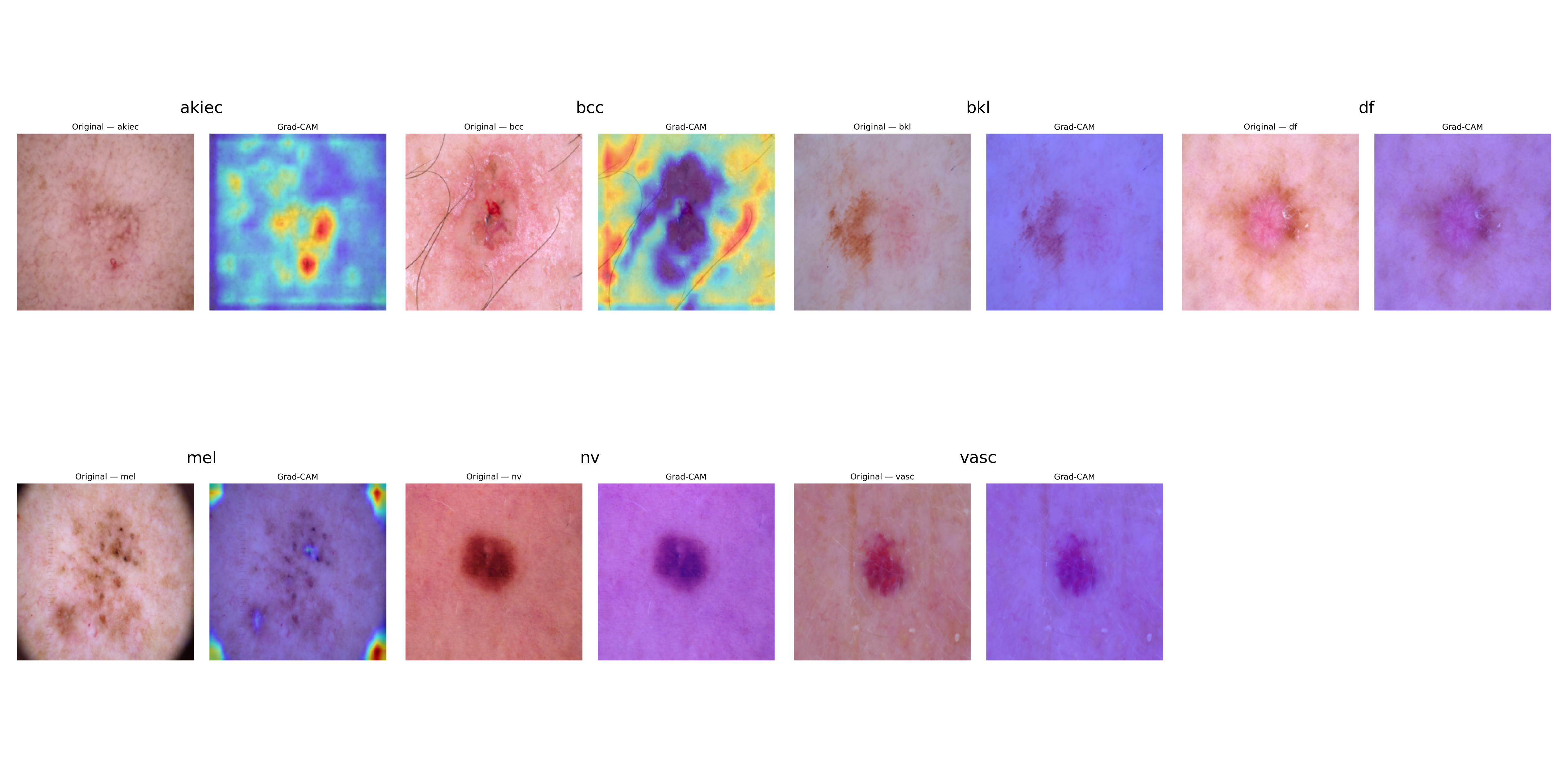
Grad-CAM visualizations across multiple lesion classes demonstrate that the ensemble focuses on clinically relevant regions and lesion boundaries, improving interpretability and trust for medical decision support.
Publication Status
This work forms the basis of an currently under review in a Q1-level journal focused on generalizable and explainable deep learning systems for medical image analysis.
Repository
The complete implementation, training pipelines, evaluation scripts, and reproducibility materials are available at:
https://github.com/md-naim-hassan-saykat/skin-lesion-classification-ensemble-ham10000